


Materials Center Leoben Forschung GmbH
Business Area Services

Material Testing - Hydrogen Pressure Tests Now Available

With our new testing system, MCL investigates materials under realistic hydrogen conditions, an essential step toward ensuring safety in hydrogen-based energy applications.

Test the crack growth behavior and strength properties of your materials under the influence of pressurized hydrogen

– New testing facility now available at MCL

Pressurized hydrogen testing – why is it so important?

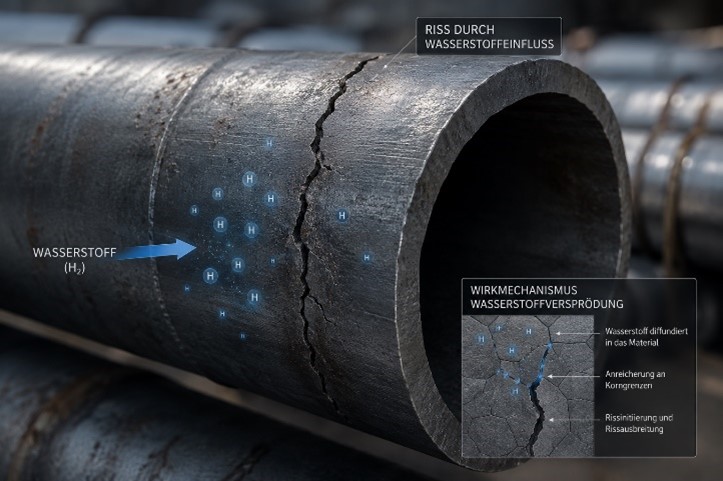
Hydrogen is considered a key technology for the energy transition. At the same time, it poses unique challenges for materials. The diffusion of hydrogen into metallic materials can lead to embrittlement, altered crack growth, and a reduced service life of components.

Conventional material testing under ambient atmosphere is therefore often insufficient to reflect the actual operational behavior of components in hydrogen applications. Pressurized hydrogen testing provides the necessary data for the safe design, material selection, and service life assessment of components and systems. 

Crack growth as a key parameter

A key focus of the new facility is the investigation of fatigue crack growth under the influence of hydrogen. Especially in components subjected to cyclic loading, hydrogen can significantly accelerate crack propagation and thus have a major impact on the service life of safety-critical components.

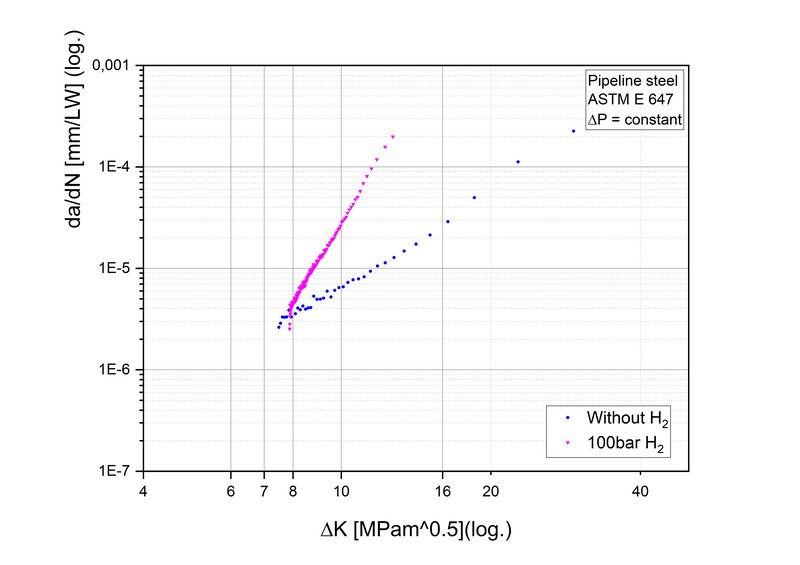
Recent studies on pipeline steel clearly demonstrate this effect. Fatigue crack growth tests on CT specimens (25 × 6 mm) in accordance with ASTM E647 at room temperature and a load ratio of R = 0.5 show significantly higher crack growth rates under 100 bar of hydrogen than under reference conditions in air. The determined Paris lines exhibit a significantly steeper slope and confirm the strong influence of hydrogen on the material’s damage behavior.


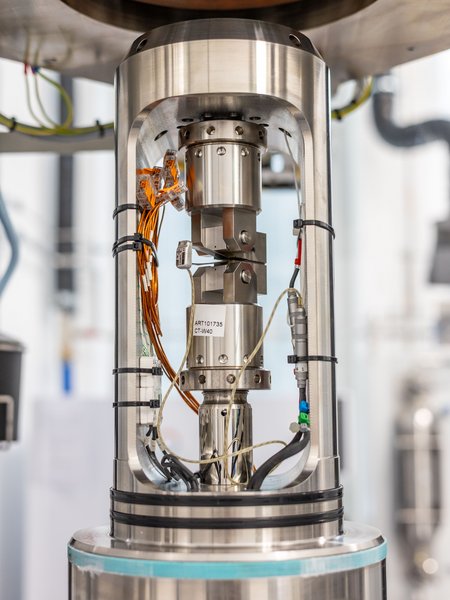
The DCPD (Direct Current Potential Drop) method is used for high-resolution measurement of crack propagation. It enables the precise determination of crack length during the ongoing test. The successful integration of this measurement technique into the pressurized hydrogen testing system opens up new possibilities for detailed fracture mechanics investigations under realistic operating conditions.

The facility is now available for booking

With this new testing capability, companies, research institutions, and development partners now have access to a powerful platform for characterizing materials and components under realistic hydrogen conditions.

Are you planning material qualification tests, service life assessments, or fracture mechanics studies for hydrogen applications? The facility is available immediately and can be used for customized testing programs.


  • Static material testing for strength characterization
  • Cyclic fatigue tests (LCF and low-frequency HCF)
  • Fatigue crack growth studies (da/dN – ΔK)
  • Fracture mechanics studies (KIC, J-R curves, ΔKth)
  • Comparative tests in air and hydrogen
  • Studies on hydrogen embrittlement with a focus on strength, ductility, and service life


Technical Requirements

  • Hydrogen operation up to 400 bar
  • Test force range up to ±100 kN
  • Temperature range from −50 °C to +150 °C
  • High-resolution crack length measurement using DCPD


For more information:
https://services.mcl.at/lab-services/mechanische-werkstoffpruefung

Contact:
services(at)mcl.at

Why this matters:
Hydrogen can cause embrittlement and accelerate crack growth, making conventional testing approaches insufficient in many cases.
A key focus is fracture mechanics. Initial results clearly show significantly higher crack growth rates in hydrogen compared to air.

Our services:
✅ Static testing (e.g., slow strain rate tests) and cyclic testing (e.g., LCF and low-frequency HCF)
✅ Fracture mechanics characterization (KIC, J-R curves, da/dN, ΔKth)
✅ Comparative testing in air and hydrogen environments
✅ Investigations of hydrogen embrittlement

Technical highlights:
✔️ Hydrogen pressure up to 400 bar
✔️ ±100 kN load capacity
✔️ Temperature range from −50 °C to +150 °C
✔️ Crack monitoring via DCPD

➡️ Are you developing materials, pipelines, pressure vessels, or components for hydrogen applications?

The facility is now available and can be booked for customized testing programs. Get in touch for material qualification, lifetime assessment, or fracture mechanics testing under hydrogen.


More information: https://services.mcl.at/lab-services/mechanische-werkstoffpruefung

Contact: services@mcl.at