

Optimization of Wireless Sensor Nodes for Condition Monitoring
Plan, test, and optimize the lifetime of your energy-autonomous wireless sensor nodes by considering algorithms and the resulting data transmission before building prototypes or making critical design decisions.
The problem
The operational capability of energy-autonomous wireless sensor nodes depends on their energy consumption as well as the energy harvested from the environment. Energy consumption, in turn, is determined by the algorithms executed on the WSN and the amount of transmitted data. Condition monitoring problems can typically be solved using a wide range of algorithms. However, particularly on microcontrollers, different algorithms of comparable accuracy may exhibit significantly different execution times, memory requirements, and energy demands. In practice, the classification accuracy of various algorithms is evaluated beforehand. Due to the required implementation effort, however, only a small number of algorithms are typically implemented on the WSN, where their execution time and energy consumption are then measured. This results in an insufficient basis for decision-making and potentially leads to suboptimal design choices. The consequences may include longer development cycles and/or sensor nodes that are oversized and therefore more expensive than necessary.Compiling different algorithms for microcontrollers and measuring their respective energy consumption on prototypes is time-consuming and expensive.
Our capability
The MCL maintains a WSN simulation and analysis framework (MCL WSN*Explorer), that can be used to automatically execute algorithms on microcontrollers and measure their execution time and energy consumption. The results are then fed into a realistic simulation of wireless sensor nodes (WSNs) under realistic application conditions.Your benefits
We map your (WSN & algorithm) solution space – efficiently and accurately. You receive a comprehensive report that can serve as the basis for a product decision. You can then concentrate on the best solution options.

Algorithms
- Constructing and validating algorithms for condition monitoring of physical systems
- Compiling Scikit-learn algorithms into executable ARM binaries
- Automated measurement of execution time and energy consumption on selected microcontrollers
- Automated reporting
- Automatic generation of description files for WSN simulation
WSN simulation
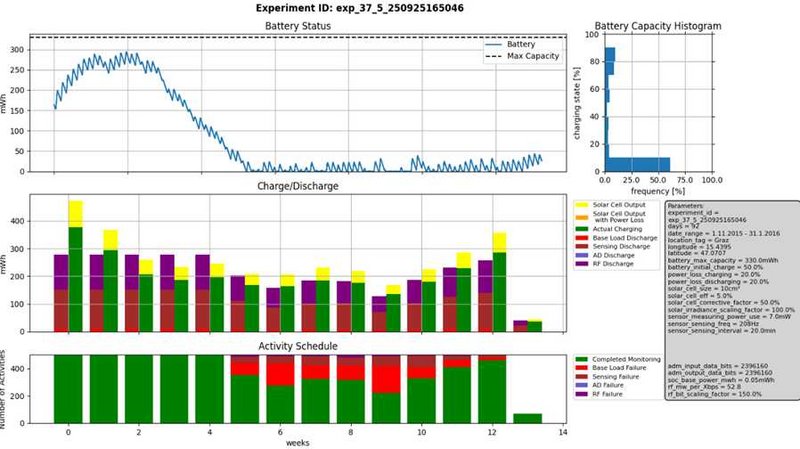
- Realistic energy models: Simulation of energy flows with solar harvesting (PV), simplified battery charging/discharging behavior, and sleep/wake states.
- Communication costs at a glance: Simplified RF energy model per bit/packet
- Cycles with real data: The WSN*Explorer is the combination of different operating cycles (e.g., measurement, transmission, and sleep phases) with real-world data. Currently, historical solar irradiance data is automatically downloaded from the Internet and integrated into the energy model.
Uptime optimization — We provide metrics that allow you to evaluate how stable the system runs over days, weeks, and seasons—including worst-case weather and peak load options.
What We Need From You
- Algorithms to be executed in ONNX format, or an appropriate dataset
- A microcontroller architecture and an available development board
- Example WSN configurations and parameter ranges (desired design space)
| Dr. Julien Magnien | services(at)mcl.at | +43-676 848883 640 |