(Local) Chemical Analysis in the Electron Microscope
(Lokale) Chemische Analytik im Elektronenmikroskop:
(Local) Chemical Analysis in the Electron Microscope
Methods
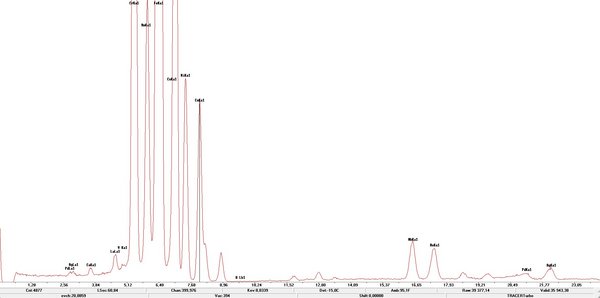
- EDX (Energy Dispersive X-ray Spectroscopy)
Lateral resolution down to 50 nm; windowless detectors for light elements.
Fast qualitative and quantitative elemental analysis, spot analyses, and elemental mapping. - WDX (Wavelength Dispersive X-ray Spectroscopy)
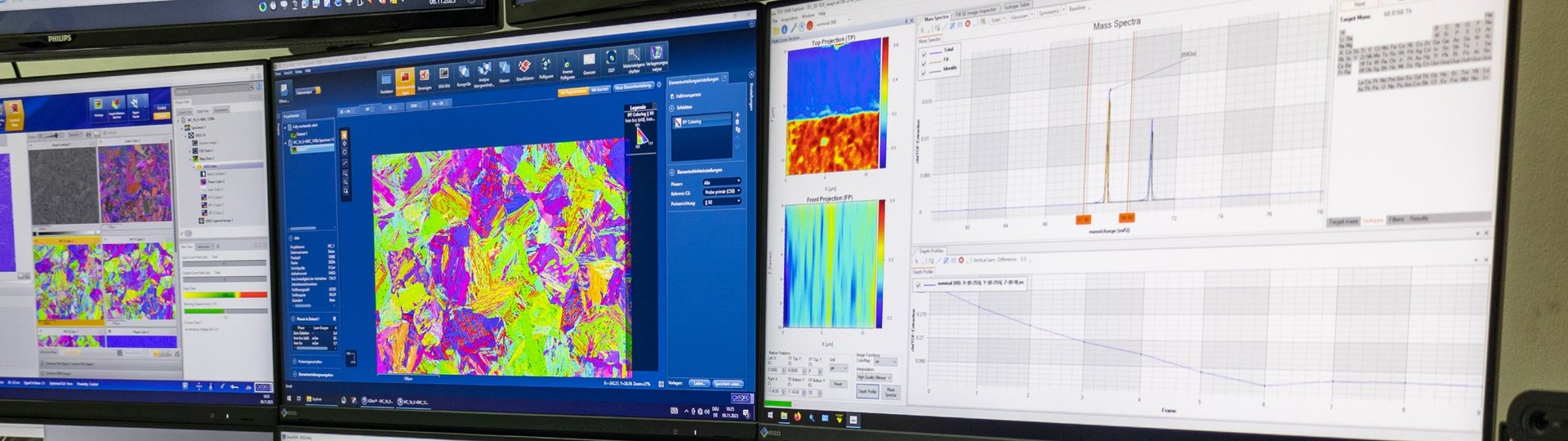
Highest resolution and detection limits, precise quantification. - FIB-SIMS (Focused Ion Beam – Secondary Ion Mass Spectrometry)
Depth profiles, trace elements, isotope-specific analysis, 3D chemical mapping. - X-ray Fluorescence Analysis (XRF)
Low-damage, larger analysis volumes, elemental mapping down to trace levels.
Fields of application
Phase characterization and precipitate analysis
- Identification of carbide, nitride, and intermetallic precipitates
- (e.g. Cr carbides in stainless steels, Al-Mg-Si precipitates in Al alloys)
- Analysis of precipitate size, distribution, and chemistry
- Detection of undesired phases (σ-phase, Laves phase, Widmanstätten structures)
Particle, inclusion, and cleanliness analysis
- Chemical assessment of impurities such as non-metallic inclusions
(MnS, various oxides like Al₂O₃, SiO₂) - Automated particle size and distribution analysis
- Evaluation of steel cleanliness in line with standards (e.g. DIN/ASTM)
- Investigation of foreign particles in steelmaking, casting, and rolling processes
Identification of spallation, wear debris, and abrasion particles
Local microstructure and microstructural analysis
- Chemical analysis of individual microstructural constituents (heterogeneous materials, e.g. hardmetals/cemented carbides)
- Determination of segregations and microsegregations (e.g. Cr, Mo, Nb)
- Correlative analysis of microstructure vs. chemical composition
Identification of local corrosion initiators (MnS, intermetallic particles, foreign particles)
Coating properties and layer structure
- Analysis of multilayer systems (electroplated coatings, PVD, CVD, thermal spray coatings)
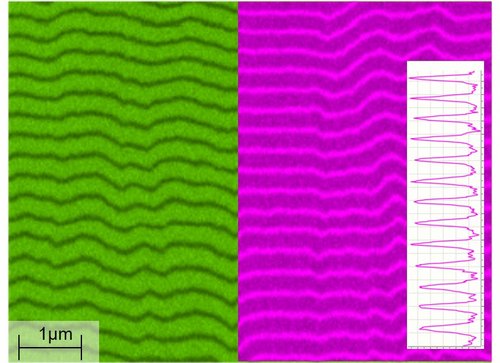
- Determination of layer thicknesses, diffusion zones, and composition gradients
- Detection of elemental enrichments or depleted regions (e.g. Cr-depleted areas)
- Investigation of passive layers, oxides, and corrosion products
Surface modification
- Chemical evaluation of nitrided, carbonitrided, and borided layers
- Analysis of coating adhesion, interfaces, and delamination
- Investigation of local hardness gradients via elemental distributions (C, N diffusion)
Depth profiling & nanoscale analysis (FIB-SIMS)
- Sub-micron depth profiles of coatings, diffusion layers, etc.
- Detection of trace and light elements (e.g. H, Li, B, N)
- Analysis of local contamination in the ppm range
- Investigation of hydrogen embrittlement (H mapping)